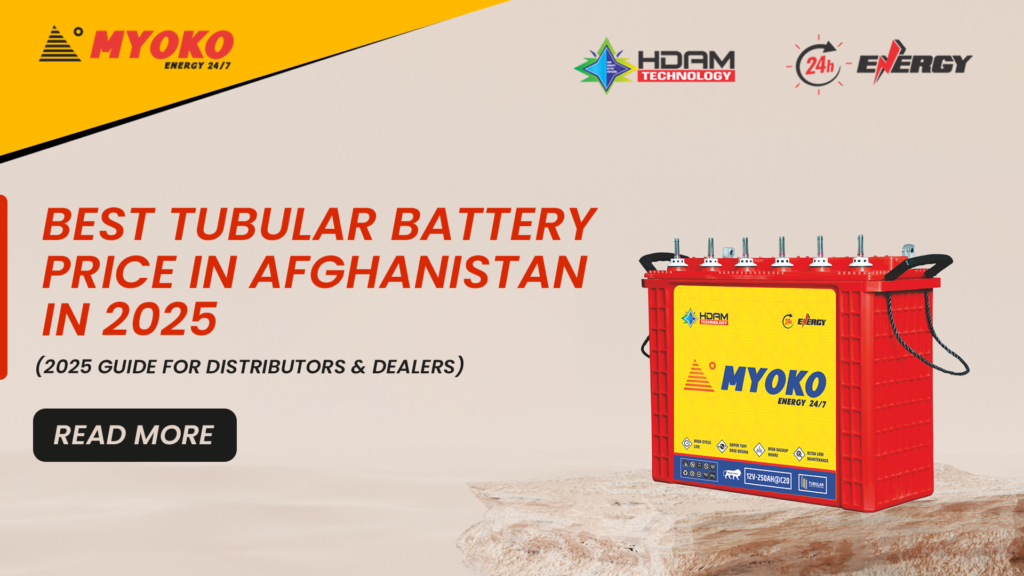
The best tubular battery price in Afghanistan in 2026 ranges from $110 to $350, depending on capacity (Ah rating), build quality, warranty coverage, and import source. On average:
100Ah tubular battery → $110–$150
150Ah tubular battery → $160–$210
200Ah tubular battery → $220–$300
220Ah+ tubular battery → $280–$350+
Prices may slightly vary across major cities such as Kabul, Herat, Kandahar, and Mazar-i-Sharif due to logistics costs, distributor margins, and exchange rate fluctuations.
Now let’s examine tubular battery pricing, performance, and why MYOKO tubular batteries are a strong option in Afghanistan.
Why Tubular Batteries Remain in High Demand in Afghanistan
Afghanistan continues to experience unstable electricity supply, frequent power outages, and voltage fluctuations. Because of these grid reliability challenges, inverter systems and solar backup systems have become essential for:
Residential homes
Retail shops
Clinics and pharmacies
Offices and small enterprises
Rural electrification projects
Tubular batteries remain popular because they offer:
Strong deep-cycle performance
Reliable backup during long outages
Affordable upfront cost
Wide service and maintenance availability
For price-sensitive markets, tubular batteries provide a practical balance between cost, durability, and operational reliability.
Detailed Tubular Battery Price Breakdown (2026)
Tubular battery prices are mainly influenced by capacity and quality. Below is a structured estimate:
| Capacity | Suitable For | Estimated Price |
|---|---|---|
| 100Ah | Basic home load (lights, fans) | $110 – $150 |
| 150Ah | Moderate residential load | $160 – $210 |
| 200Ah | Heavy home/office load | $220 – $300 |
| 220Ah+ | Extended backup needs | $280 – $350+ |
Higher ampere-hour (Ah) capacity directly increases backup duration and cost.
Key Factors That Influence Tubular Battery Prices
1. Capacity (Ah Rating)
Capacity determines backup duration.
100Ah battery supports small loads for limited hours.
150Ah battery supports moderate usage.
200Ah battery supports longer backup with heavier appliances.
Higher capacity requires more lead material, increasing manufacturing cost.
2. Plate Thickness and Internal Design
Premium tubular batteries use thicker positive plates, which:
Improve deep discharge tolerance
Increase cycle life
Enhance structural durability
Better internal design slightly increases cost but improves lifespan.
3. Warranty Period
Warranty options typically include:
12 months
24 months
36 months
Longer warranty generally reflects better manufacturing quality and increases price slightly.
4. Import and Transportation Cost
Most tubular batteries sold in Afghanistan are imported. Pricing is influenced by:
Shipping costs
Customs duties
Currency exchange rates
Distributor margin
This is why prices vary between cities and suppliers.
MYOKO Tubular Battery – Complete Technical Explanation
MYOKO tubular batteries are engineered for deep-cycle inverter and solar applications. They are designed to handle frequent power interruptions while maintaining performance stability.
Below is a detailed technical breakdown:
| Parameter | MYOKO Tubular Battery Specification |
|---|---|
| Battery Type | Lead-Acid Tubular |
| Technology | Advanced deep-cycle tubular plate |
| Application | Inverter & solar backup systems |
| Lifespan | 5–7 years (with proper maintenance) |
| Life Cycles | 1200–1500 cycles |
| Voltage | 12V standard |
| Capacity Range | 100Ah, 150Ah, 200Ah, 220Ah+ |
| Recommended DoD | 50–60% |
| Charging Time | 8–12 hours |
| Efficiency | 70–80% |
| Maintenance | Requires distilled water topping |
| Installation | Floor-mounted, ventilated area |
| Gas Emission | Emits hydrogen during charging |
| Initial Investment | Budget-friendly |
| Ideal Use | Homes, offices, shops, small solar systems |
Why MYOKO Tubular Is Suitable for Afghan Conditions
MYOKO tubular batteries are particularly practical in Afghanistan because:
They tolerate deep discharge conditions common during long outages.
Maintenance procedures are simple and widely understood.
Initial investment is affordable compared to lithium alternatives.
They are compatible with standard inverter systems commonly used in Afghan households.
For customers prioritizing reliability and affordability, MYOKO tubular batteries provide a dependable solution.
Maintenance Requirements and Long-Term Performance
Tubular batteries require:
Periodic distilled water top-up
Proper ventilation
Terminal cleaning to prevent corrosion
While maintenance is necessary, it is straightforward and inexpensive. Proper care significantly improves battery life and ensures stable performance.
Neglecting water levels or ventilation can reduce lifespan and efficiency.
Tubular vs Lithium: Cost Perspective
Lithium batteries offer:
8–15 years lifespan
3000+ life cycles
95% efficiency
Fast charging
Zero maintenance
However, lithium batteries cost significantly more upfront.
For many Afghan households and small businesses, initial affordability is a key decision factor, making tubular batteries the more accessible option.
Solar Compatibility of Tubular Batteries
Tubular batteries are compatible with:
Off-grid solar systems
Hybrid solar inverters
Although their efficiency is lower than lithium batteries, they remain cost-effective for budget solar installations.
For small residential solar projects, tubular batteries offer a balanced price-to-performance ratio.
How to Choose the Right Tubular Battery
Before purchasing, evaluate:
1. Total Load Requirement
Calculate the wattage of appliances you want to run.
2. Backup Duration
Decide how many hours of backup you require.
3. Inverter Compatibility
Confirm voltage and Ah compatibility with your inverter.
4. Budget Planning
Balance upfront cost with expected lifespan.
Making a structured decision prevents overspending or under-sizing.
Tips to Get the Best Tubular Battery Price in Afghanistan
To secure competitive pricing:
Compare multiple distributors.
Verify manufacturing date (avoid old stock).
Confirm warranty authenticity.
Negotiate bulk discounts if buying multiple units.
Check installation support availability.
Careful supplier selection reduces long-term risk.
Final Conclusion
The best tubular battery price in Afghanistan in 2026 typically ranges from $110 to $350, depending on capacity and quality. MYOKO tubular batteries offer reliable deep-cycle performance, affordable pricing, and compatibility with inverter and solar systems.
For households and small businesses facing frequent power cuts, tubular batteries remain a practical, cost-effective energy storage solution. While lithium batteries provide advanced efficiency and longer lifespan, tubular batteries continue to dominate the Afghan market due to lower upfront investment and easy maintenance.
Choosing the right capacity and buying from a trusted supplier ensures stable power backup for 5–7 years with proper maintenance.